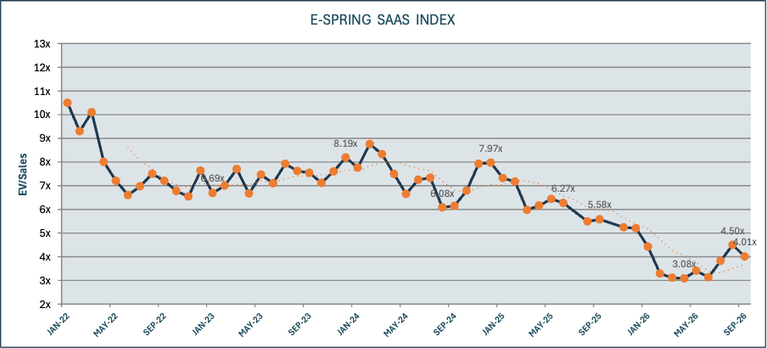
The E-Spring B2B SaaS Index is based on 40 international B2B SaaS companies. We focus on the EV/Sales multiple as it is the most commonly used valuation metric for SaaS companies. Additionally, the SaaS business model typically generates a significant percentage of recurring revenue, which is best captured by the EV/Sales multiple.
The index is the median EV/Sales of the 40 companies, based on consensus revenue estimates for the next financial year (FY+1), which is 2026 for companies with a December year end, and on market data from S&P Capital IQ1.
Global Market:
Over the twelve months to 30 September 2026, the Invesco QQQ, which tracks the NASDAQ 100, returned 23.8% including dividends, while the iShares Expanded Tech Software ETF (IGV) returned (7.4)%2. Software was left behind by the wider technology market, and the reason is specific to the sector: in the first quarter of 2026, IGV lost 24% including dividends, its weakest quarter since the fourth quarter of 20084.
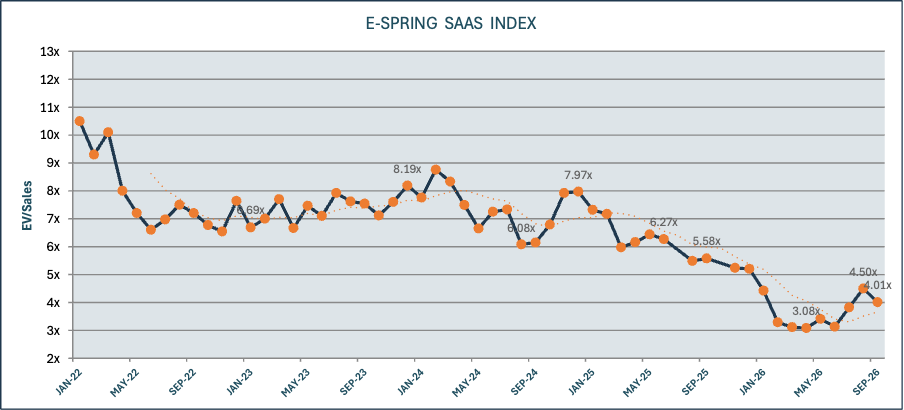
The E-Spring B2B SaaS Index stands at 4.01x EV/Sales on 30 September 2026, 28.1% below the 5.58x recorded on 30 September 2025 on the same peer group and data source. The year had three phases. The index eased from 5.58x to 5.20x between September and December 2025, fell to a low of 3.08x at the end of April 2026, and recovered to 4.50x at the end of August, before easing by about 11% in September.
Key factors behind the move:
The AI agent shock (January to April 2026): Early 2026 marked the arrival of AI agents able to carry out complete professional tasks, such as drafting, analysis and reporting, rather than simply assisting a user. As several of these tools were released in January and February, including Anthropic’s Claude Cowork and its plugins for specific job functions5, investors began to question the business model of application software. Most SaaS products are priced per user: if an agent does part of the work, clients may need fewer licences, and some products risk being bypassed altogether. Fortune reported fears that such tools could make traditional SaaS products obsolete6. On 3 February 2026, the S&P Software & Services Index fell 4% in a single session, wiping out more than $285 billion of market value, and it lost 25% in total between 12 January and 23 February5. Sentiment began to stabilise once it became clear that agents also depend on established software: from late February, AI providers announced integrations with incumbent applications such as Salesforce, Docusign and Intuit, which presented these vendors as platforms that agents connect to rather than products they replace5.
What our index shows: The move was general. In February 2026 alone, all 40 companies in our index saw their multiple fall, with a median decline of 19%. Between the end of December 2025 and the end of April 2026, the companies all traded lower, with a median decline of 41%. Large falls included monday.com (4.95x to 0.95x), HubSpot (6.38x to 2.70x), Workday (5.58x to 2.80x) and Salesforce (6.00x to 3.31x), while Datadog fell by a smaller 20% over the same period.
The recovery (May to August 2026): The recovery came from results: ServiceNow, for example, saw its shares rise 40% between its second quarter results on 22 July and 30 September 20267. In our index, 37 of 39 companies traded higher at the end of August than at the end of April, with a median increase of 45%.
Company level view:
Over twelve months, the decline remains broad based: 35 of the 40 companies with a multiple on both dates trade lower, the median company lost 23% of its multiple, and 11 companies now trade below 3x, against 2 in September 2025.
The table shows the largest moves between the two dates.
| Company | EV/Sales 30 Sep 2025 | EV/Sales 30 Sep 2026 | Change |
| monday.com | 7.01x | 1.70x | (76%) |
| HubSpot | 7.56x | 2.48x | (67%) |
| Wix.com | 5.01x | 1.81x | (64%) |
| Nemetschek | 11.05x | 5.05x | (54%) |
| BlackLine | 4.84x | 2.26x | (53%) |
| Autodesk | 9.59x | 5.17x | (46%) |
| Datadog | 14.31x | 21.31x | 49% |
| JFrog | 9.83x | 17.26x | 76% |
EV/Sales on forward revenue estimates (FY+1). Source: S&P Capital IQ1.
Growth still orders the index: the faster growing half of the companies, ranked by revenue growth over their last reported financial year, trades at a median 5.11x, against 3.81x for the slower half.
What it means for private software companies:
Listed multiples are a reference point, not a price list. Private software companies are valued in negotiated transactions, where buyers pay for control, synergies and the specific quality of a business. Five points stand out for founders and shareholders considering a transaction.
Private multiples moved less: According to Software Equity Group, private SaaS transactions were concluded at 4.0x revenue in the second quarter of 2026, against 3.2x for listed SaaS over the same period9. Private valuations did not follow the full public derating, partly because acquirers price long term ownership rather than daily market sentiment. Listed multiples still shape buyers’ expectations, however, and a seller anchoring on 2021 or 2025 references should expect a more demanding discussion.
Lower prices attract buyers: The companies that left our index this year show how financial and strategic buyers react to lower listed valuations. Thoma Bravo acquired Dayforce11, Permira and Warburg Pincus took Clearwater Analytics private13, IBM acquired Confluent to strengthen its data offering for enterprise AI12, and Iress has confirmed takeover talks with Blackstone and Thoma Bravo18. Private equity funds and strategic acquirers continue to see value in software, and international buyers remain active.
Quality is paid for: Within our index, the faster growing half of the companies trades at a multiple about a third higher than the slower half. The same logic applies in private transactions: growth, a high share of recurring revenue, low churn and profitability explain most of the gap between a modest and a premium valuation. Smaller companies generally trade at a discount to the large listed vendors in our index, which makes these quality factors even more decisive.
AI is now a due diligence question: Since the start of 2026, acquirers want to understand how exposed a target is to AI agents. Sellers should expect questions on whether the product could be bypassed by an agent, whether pricing depends on user seats, and how the company uses AI in its own offering. Vendors that own proprietary data, are deeply embedded in their clients’ workflows or serve regulated niches are generally seen as more resilient. A clear answer to these questions, prepared before the process starts, supports value.
Preparation and process matter more: When listed references are volatile, the price a seller obtains depends even more on the quality of preparation and on competition between buyers. Reliable recurring revenue data, a clear equity story and access to several credible acquirers, including international ones, remain the best ways to protect value.
What we will be watching:
We do not attempt to forecast where listed multiples will go next. In our view, three factors will shape how software valuations evolve: whether third quarter results confirm the operating strength seen over the summer; the pace of revenue growth, with consensus below 10% for 20278; and how clearly software vendors demonstrate that AI agents add to their products rather than replace them. The September easing is a reminder that the sector remains sensitive to each new AI announcement.
Conclusion:
Listed B2B SaaS trades at 4.01x forward sales, 28.1% below its level of September 2025 on the same peer group and data source. The year was shaped by the arrival of AI agents designed for professional work, which triggered a sharp and general derating and took the index to 3.08x at the end of April 2026, before strong results brought part of the value back over the summer.
For owners of private software companies, the picture is more nuanced than the headline figure suggests: private deal multiples have held up better than listed ones, buyers remain active, and growth, recurring revenue and resilience to AI continue to command a premium.
Written by Zoubayr Tbez
In & Out:
Market consolidation has again shaped the index. Four companies have left it since our last edition, and we have replaced them with three listed software companies from France and one from the United States, which also increases the weight of European companies in the index.
Out Companies:
- Matterport (28 February 2025): Matterport was acquired by CoStar Group10. Its multiple was not available in our 2025 index sheets, so it did not contribute to the index, and it is now removed from the peer group.
- Dayforce (4 February 2026): Thoma Bravo completed the acquisition of Dayforce, a transaction reported at $12.3 billion11.
- Confluent (17 March 2026): IBM completed its acquisition of Confluent for about $11 billion in cash, and Confluent was delisted from Nasdaq12.
- Clearwater Analytics (25 June 2026): Clearwater Analytics completed its $8.4 billion take private acquisition by Permira and Warburg Pincus13.
In Companies:
- Planisware (Euronext Paris: PLNW): A French provider of SaaS platforms for strategic portfolio management and project execution. Recurring revenue represented 91% of H1 2026 revenue, which grew by 14.8% at constant currency14. EV/Sales 2026: 6.68x.
- Wallix (Euronext Growth Paris: ALLIX): A French cybersecurity software publisher. Recurring revenue represented 81% of H1 2026 revenue, which grew by 14.2% to €20.6 million15. EV/Sales 2026: 3.14x.
- Dassault Systèmes (Euronext Paris: DSY): A French provider of 3D design, simulation and product lifecycle software for industry and life sciences, built around its 3DEXPERIENCE platform. Second quarter 2026 revenue was €1.56 billion, up 4% at constant currency, with subscription revenue up 8% and a non IFRS operating margin of 30%16. EV/Sales 2026: 3.91x.
- Box (NYSE:BOX): A US provider of cloud content management and collaboration software, sold by subscription to businesses. Revenue grew by 8.0% in its last reported financial year17. EV/Sales: 4.04x.
Methodology note:
EV/Sales multiples are taken from S&P Capital IQ (diluted total enterprise value divided by consensus revenue for the next financial year, FY+1), as in previous editions, which used database multiples rather than recalculated enterprise values. Monthly values from August 2025 to August 2026 (July and October 2025 were not collected) were retrieved at each month end with the Capital IQ As Of Date function; the 30 September 2026 value was retrieved in the same way. For companies with a December year end, FY+1 is the current calendar year.
References:
- S&P Global Market Intelligence (2026). S&P Capital IQ, market data and consensus estimates for the 40 index companies. Data as of 30 September 2026.
- S&P Global Market Intelligence (2026). S&P Capital IQ, total return including reinvested dividends of the Invesco QQQ Trust, Series 1 (NASDAQGM:QQQ), 30 September 2025 to 30 September 2026.
- S&P Global Market Intelligence (2026). S&P Capital IQ, total return including reinvested dividends of the iShares Expanded Tech Software Sector ETF (BATS:IGV), 30 September 2025 to 30 September 2026.
- S&P Global Market Intelligence (2026). S&P Capital IQ, quarterly total return of the iShares Expanded Tech Software Sector ETF (BATS:IGV), first quarter of 2026 compared with quarterly returns since 2008.
- DeepLearning.AI, The Batch (27 February 2026). Investors Panic Over Agentic AI: Claude Cowork plugins trigger a SaaS stock selloff, but partnerships lead to slight rebound. Retrieved from: https://www.deeplearning.ai/the-batch/claude-cowork-plugins-trigger-a-saas-stock-selloff-but-partnerships-lead-to-slight-rebound
- Fortune (6 February 2026). Anthropic’s Claude triggered a trillion-dollar selloff. A new upgrade could make things worse. Retrieved from: https://fortune.com/2026/02/06/anthropic-claude-opus-4-6-stock-selloff-new-upgrade/
- S&P Global Market Intelligence (2026). S&P Capital IQ, ServiceNow (NYSE:NOW) closing prices on 22 July 2026 and 30 September 2026.
- Aventis Advisors (31 August 2026, updated 4 September 2026). SaaS Valuation Multiples: 2015 to 2026. Retrieved from: https://aventis-advisors.com/saas-valuation-multiples/
- Software Equity Group (5 August 2026). 2Q26 SaaS M&A and Public Market Report. Retrieved from: https://softwareequity.com/research/quarterly-saas-report
- CoStar Group (28 February 2025). CoStar Group Completes Acquisition of Matterport. Retrieved from: https://www.costargroup.com/press-room/2025/costar-group-completes-acquisition-matterport-ushering-new-era-3d-digital-twins-and
- Thoma Bravo (4 February 2026). Thoma Bravo Completes Acquisition of Dayforce. Retrieved from: https://www.globenewswire.com/news-release/2026/02/04/3232075/0/en/thoma-bravo-completes-acquisition-of-dayforce.html
- IBM (17 March 2026). IBM Completes Acquisition of Confluent. Retrieved from: https://newsroom.ibm.com/2026-03-17-ibm-completes-acquisition-of-confluent,-making-real-time-data-the-engine-of-enterprise-ai-and-agents
- Permira (25 June 2026). Clearwater Analytics Completes $8.4 Billion Take Private Acquisition by Permira and Warburg Pincus. Retrieved from: https://www.permira.com/news-and-insights/announcements/clearwater-analytics-completes-84-billion-take-private-acquisition-by-permira-and-warburg-pincus
- Planisware (30 July 2026). H1 2026 results. Retrieved from: https://planisware.com/resources/corporate-news/strong-h1-2026-driven-accelerating-revenue-growth-and-excellent
- Boursorama (17 July 2026). Wallix accroît de plus de 14% son CA au 1er semestre. Retrieved from: https://www.boursorama.com/bourse/actualites/wallix-accroit-de-plus-de-14-son-ca-au-1er-semestre-71f57ca5a5d9dedf4485e9edaf632778
- Dassault Systèmes (23 July 2026). Dassault Systèmes solid Q2 results and confirming full year objectives. Retrieved from: https://www.3ds.com/newsroom/press-releases/dassault-systemes-solid-q2-results-and-confirming-full-year-objectives-delivering-ai-native-solutions-and-expanding-life-sciences-acquisition-arisglobal
- S&P Global Market Intelligence (2026). S&P Capital IQ, Box, Inc. (NYSE:BOX) financials and consensus estimates, data as of 30 September 2026.
- Investing.com, Reuters (August 2025). Australia’s Iress in early talks with Blackstone, Thoma Bravo over buyout offer. Retrieved from: https://www.investing.com/news/stock-market-news/australias-iress-in-early-talks-with-blackstone-thoma-bravo-over-buyout-offer-4178701